Gastric balloons for obesity
Who benefits, how much weight patients lose, and when symptoms warrant early removal.
What you’ll learn
- Candidate selection
- Expected benefit
- Placement & follow-up
- Symptoms
- After removal
The consultation
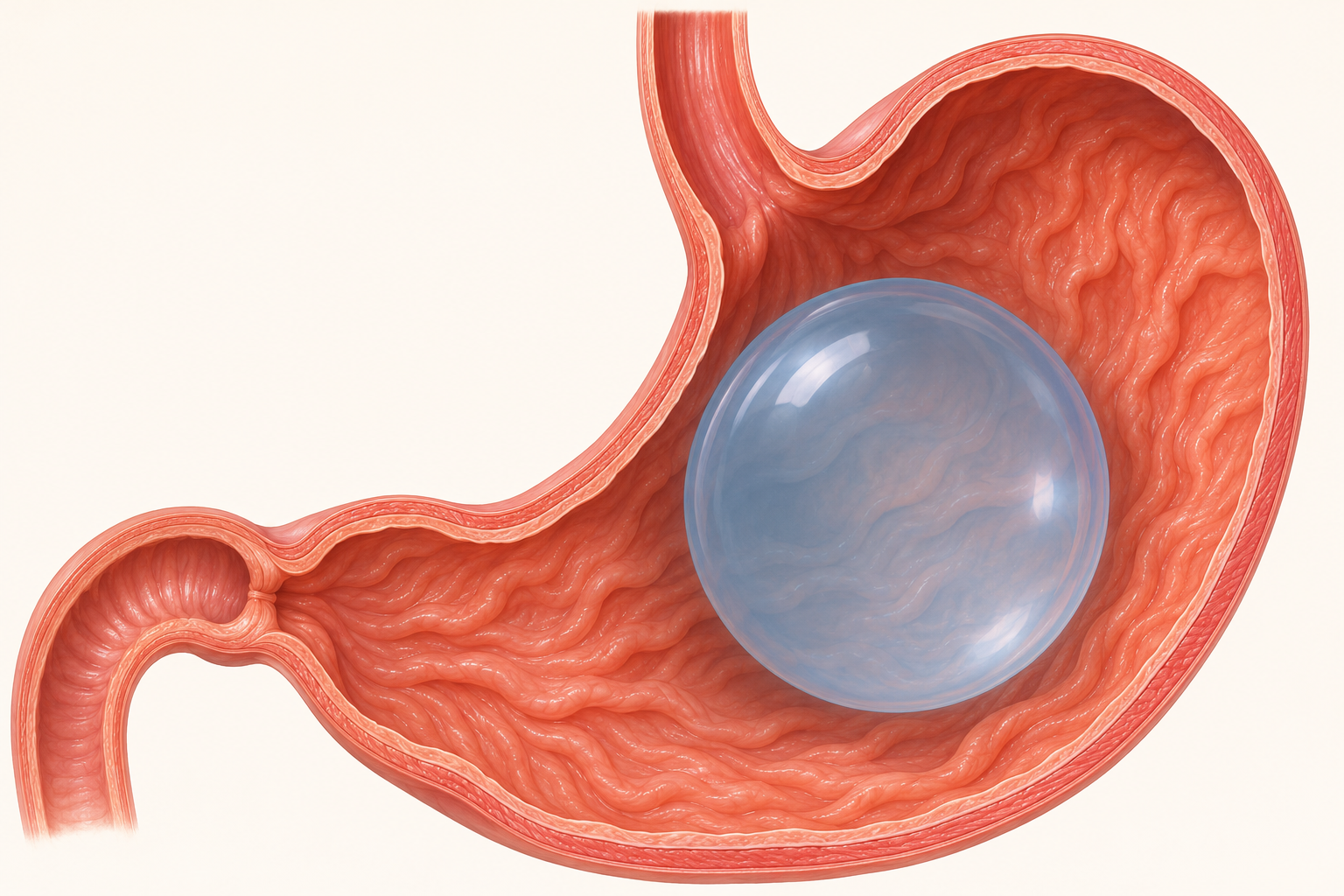
A patient with a BMI of 35 kg/m² asks for a temporary procedure after a supervised program has produced little lasting weight loss. Before discussing placement, ask two questions. Can the patient safely keep a balloon in the stomach and return for removal? What treatment will take its place when it comes out? The answers affect both safety and the durability of any weight loss. [1] [3] [4]
Who is a candidate?
The AGA suggests offering an intragastric balloon alongside structured lifestyle treatment when conventional measures have fallen short and the patient wants another option. The 2024 ASGE–ESGE guideline also conditionally supports balloons plus lifestyle treatment in adults with obesity, with moderate certainty of evidence. Discuss the patient's weight-related health priorities, prior treatment response, medication options, surgical options, cost and willingness to undergo both placement and retrieval. [1] [2] [8]
| Clinical finding | How it changes the decision |
|---|---|
| BMI and comorbidity | ASGE–ESGE considers endoscopic bariatric therapies broadly at BMI ≥30, or 27–29.9 with a weight-related comorbidity. The US ORBERA indication specifies adults with BMI 30–40 kg/m² inclusive after unsuccessful conservative therapy. Check the label for the exact device. |
| Foregut history | Review operative records, previous ulcers, bleeding, dysphagia and reflux. ORBERA contraindications include prior GI or bariatric surgery, active ulceration, varices, and a hiatal hernia >5 cm or a smaller hernia with severe or intractable reflux. |
| Systemic risk | Cirrhosis, severe coagulopathy, pregnancy and breastfeeding are among the labeled exclusions. Review antithrombotics and gastric irritants, procedural fitness, and any condition that would impede safe endoscopic retrieval. |
| Capacity for follow-up | Confirm access to the implanting team, urgent care, acid suppression, nutrition support and timely removal. Defer placement when safe retrieval or follow-up cannot be secured. |
[2] [3] For example, BMI 28 with diabetes warrants an obesity treatment discussion. It falls outside the cited US ORBERA indication. A patient with BMI 35 and prior sleeve gastrectomy also falls outside appropriate selection for this device.
How much weight loss is realistic?
In the US open-label pivotal trial, 255 adults with BMI 30–40 were assigned to ORBERA plus lifestyle treatment (125) or lifestyle treatment alone (130). Both groups continued lifestyle care through month 12. By removal at six months, mean loss was 10.2% versus 3.3% of starting weight. At a starting weight of 100 kg, these percentages correspond to about 10 kg versus 3 kg. Individual responses vary. [4] [5]
| Time | Balloon + lifestyle | Lifestyle alone |
|---|---|---|
| 6 mo · removal | 10.2 (9.0–11.4) | 3.3 (2.4–4.2) |
| 9 mo | 9.1 (7.9–10.3) | 3.4 (2.4–4.3) |
| 12 mo | 7.6 (6.2–8.9) | 3.1 (2.0–4.1) |
The between-group difference narrowed from 6.9 percentage points at removal to 4.5 at one year. The FDA analysis used a modified intention-to-treat population and carried the last observation forward for missing measurements. The endpoint is percentage of starting weight lost. These estimates describe one device and a lifestyle comparator. They cannot establish comparative efficacy against current obesity medications or surgery. [4] [5]
From referral to removal
- At consultation → select the treatment. Review the exact device label, patient goals and alternatives. Arrange the retrieval date and name the clinician responsible for ongoing weight management.
- At endoscopy → confirm suitability. Inspect for anatomy or mucosal disease that precludes placement. If an exclusion is found, stop and address it. For eligible patients, the trained endoscopy team places the balloon and confirms its intragastric position.
- During adaptation → actively manage symptoms. Give written instructions on hydration, advancing intake, medication use and whom to call. Check oral tolerance early. Persistent or worsening symptoms lead to clinical reassessment.
- During treatment → track benefit and tolerance. Follow weight as a percentage of baseline, dietary intake, reflux and vomiting. Review progress with the patient and dietitian, including whether the original health goal is being met.
- By the device deadline → retrieve and transition. For the six-month US ORBERA device, complete removal by six months. Earlier removal can be necessary for complications or persistent intolerance.
Write the supportive-care orders
The AGA recommends a moderate- to high-intensity lifestyle program and prophylactic proton pump inhibition. For ORBERA, confirm the patient can take the prescribed PPI throughout implantation. Coordinate with anesthesia to minimize postoperative nausea. The AGA suggests perioperative antiemetics and a scheduled antiemetic for the first two weeks, individualized to contraindications and local practice. ASGE–ESGE also suggests periprocedural analgesia and antiemetics, with very low certainty for these recommendations. [1] [2] [3]
The AGA suggests one to two adult multivitamin doses daily after placement and advises against routine perioperative micronutrient screening. Persistent emesis, poor intake or signs of deficiency change the question from screening to diagnostic assessment. Reassess hydration, electrolytes and nutritional risk promptly. [1] [3]
When nausea or pain changes the plan
In the pivotal study's balloon safety cohort, 30 of 160 patients (18.8%) underwent early removal because of an adverse event or personal request. The safety cohort included additional balloon recipients beyond the randomized efficacy arm. A separate 258-patient postmarketing study reported device- or procedure-related serious adverse events in 8.9% (one-sided upper confidence limit 12.4%). These endpoints measure different outcomes. [3] [4] [7]
| Presentation | Clinical concern and immediate action |
|---|---|
| Early nausea, cramping or reflux, improving with oral fluids tolerated | Review intake and prescribed antiemetic and PPI use. Arrange close follow-up. An inability to keep down fluids, reduced urine output or worsening pain warrants urgent reassessment. |
| New distention, severe vomiting, dyspnea or inability to tolerate liquids | Consider spontaneous hyperinflation or gastric outlet obstruction. Arrange urgent evaluation, assess volume status, and contact the bariatric endoscopy team for imaging and possible early removal. |
| Severe epigastric pain radiating to the back | Consider balloon-associated pancreatitis as well as other causes. Obtain urgent clinical assessment, lipase and imaging as indicated. Involve the implanting team early. |
| Sudden loss of fullness or obstructive symptoms | Consider balloon leakage and migration. Contact the team promptly to locate the device. Colicky pain with vomiting or obstipation warrants emergency assessment for small-bowel obstruction. |
| Hematemesis, melena, peritoneal findings or instability | Evaluate emergently for bleeding or perforation. Stabilize the patient and involve endoscopy and surgical teams according to the suspected complication. |
FDA safety communications describe hyperinflation and pancreatitis with liquid-filled balloons. The timing of symptoms alone cannot exclude a serious complication. Communicate the device type, placement date and implanting center when transferring care. [3] [6]
Make the removal visit a treatment decision
Document removal and compare the current weight with baseline and the lowest weight reached. Ask what changed during treatment, including hunger, meal size, activity, medication tolerance and access to follow-up. Agree on the next intervention and schedule reassessment. Options include continued structured dietary treatment, obesity pharmacotherapy, another balloon in a suitable patient, or evaluation for metabolic surgery. Choose according to comorbidity, prior response, procedural tolerance and patient preference. [1] [8]
References and scope
Original educational synthesis for clinicians. References support the sections linked above; their publication dates and scopes are shown separately from this guide’s source check. No source figure, question-bank item or guideline table is reproduced here.
- AGA · Intragastric balloons in obesity (2021)AGA · 2021
Clinical source
Source checked November 25, 2026 - ASGE–ESGE · Primary endoscopic bariatric therapies (2024)ASGE and ESGE · 2024
Clinical source
Source checked November 25, 2026 - FDA · ORBERA instructions for useFDA · 2015
Clinical source
Source checked November 25, 2026 - Courcoulas et al. · Randomized ORBERA trialCourcoulas et al. · 2017
Clinical source
Source checked November 25, 2026 - FDA · Pivotal trial, Table 11FDA · 2015
Clinical source
Source checked November 25, 2026 - FDA · Liquid-filled balloon safety communicationFDA · Safety communication
Clinical source
Source checked November 25, 2026 - ORBERA postmarketing safety studyORBERA postmarketing study investigators · 2020
Clinical source
Source checked November 25, 2026 - AGA · Obesity clinical guidance toolkitAGA · Clinical toolkit
Clinical source
Source checked November 25, 2026