Fatty liver treatment: who qualifies for semaglutide or resmetirom for MASH?
Confirm treatment-eligible MASH with F2–F3 fibrosis, compare FDA-labeled drug options, interpret pivotal trial outcomes, and plan monitoring.
What you’ll learn
- Distinguish cardiometabolic treatment from MASH-targeted therapy for noncirrhotic F2–F3 disease.
- Compare the two labeled therapies using clinical context, drug interactions, and tolerability.
- Interpret biopsy endpoints separately from longer-term liver outcomes.
Who needs MASH-directed treatment?
Metabolic dysfunction-associated steatotic liver disease (MASLD, formerly NAFLD) spans steatosis through advanced fibrosis. Metabolic dysfunction-associated steatohepatitis (MASH, formerly NASH) adds hepatocyte injury and inflammation. In the United States, the MASH indications for injectable semaglutide and resmetirom apply to adults with noncirrhotic disease and moderate to advanced fibrosis consistent with F2–F3. Incidental steatosis and mildly elevated alanine aminotransferase do not establish this treatment indication.
Confirm the metabolic profile, characterize alcohol exposure and review other causes of hepatic injury. Use FIB-4 as a first risk assessment, followed by appropriate secondary fibrosis testing such as vibration-controlled transient elastography, magnetic resonance elastography or an Enhanced Liver Fibrosis test. Confirm concordance and reliability before assigning a treatment stage. Consider biopsy when the etiology or fibrosis stage remains uncertain and the answer changes management. Features of cirrhosis or portal hypertension call for stage-specific evaluation instead of entry into the F2–F3 treatment pathway.
[1] Semaglutide therapy for metabolic dysfunction-associated steatohepatitis: AASLD Practice Guidance update[2] EASL-EASD-EASO guidance on the use of resmetirom and semaglutide as MASH-targeted therapy[3] Wegovy (semaglutide) U.S. prescribing information[4] Rezdiffra (resmetirom) U.S. prescribing information
Treat cardiometabolic risk and nutrition in every stage
Individualize a nutrition and activity plan that a patient can sustain. In patients with excess weight, clinically meaningful weight reduction can improve steatosis and higher degrees of weight loss are generally needed to improve steatohepatitis or fibrosis. Include resistance activity and adequate protein when muscle loss is a concern. Address diabetes, dyslipidemia, blood pressure, cardiovascular prevention, alcohol intake and sleep apnea as clinically indicated.
Diabetes or obesity may independently support use of a glucagon-like peptide-1 receptor agonist. That indication is different from prescribing a specific formulation and dose for MASH. For eligible F2–F3 patients, shared decision-making includes cost, access, likely adherence, competing comorbidity goals, adverse effects and the patient’s preferred route.
[1] Semaglutide therapy for metabolic dysfunction-associated steatohepatitis: AASLD Practice Guidance update[2] EASL-EASD-EASO guidance on the use of resmetirom and semaglutide as MASH-targeted therapy
Compare semaglutide and resmetirom
Semaglutide can align with weight management and diabetes goals, particularly in an eligible patient with obesity or type 2 diabetes. Resmetirom is an oral liver-directed thyroid hormone receptor-beta agonist. It can be considered when incretin therapy is poorly tolerated, the patient prioritizes oral therapy, or the metabolic profile favors a liver-directed approach. Review cardiovascular and lipid management before changing an existing statin.
Reconcile the exact medication, indication, route and dose. The MASH semaglutide regimen is the weekly Wegovy injection. Follow the label titration from 0.25 mg with increases generally at four-week intervals up to the 2.4 mg maintenance dose. If 2.4 mg is not tolerated, labeling allows 1.7 mg with consideration of re-escalation. Oral Wegovy and the 7.2 mg obesity dose use different labeling. Resmetirom dosing uses actual body weight. Review interacting medications before prescribing or adjusting the dose.
Check the current product label and individualized contraindications before prescribing.
Scroll the table to see all columns.
| Decision | Subcutaneous semaglutide | Resmetirom |
|---|---|---|
| Maintenance dosing | 2.4 mg weekly after escalation. Reduce to 1.7 mg if needed for tolerability. | 80 mg daily at <100 kg or 100 mg daily at ≥100 kg, subject to drug interactions. |
| Pre-treatment review | Personal or family history of medullary thyroid carcinoma, MEN2, pregnancy plans, severe gastroparesis, diabetes medicines and retinopathy. | CYP2C8 and transporter interactions, statin dose, liver status, and gallbladder history. Avoid use in decompensated cirrhosis. |
| Monitoring priorities | GI tolerance, hydration, weight and nutrition, glucose therapy, and symptoms of gallbladder disease or pancreatitis. | Liver tests and symptoms of hepatotoxicity, gallbladder events and statin toxicities. Review lipid and thyroid status as appropriate. |
| Common clinical consideration | May support several metabolic goals in one regimen. | Can be used when the patient prefers an oral regimen or incretin therapy is poorly tolerated. |
Sources[3] Wegovy (semaglutide) U.S. prescribing information[4] Rezdiffra (resmetirom) U.S. prescribing information[2] EASL-EASD-EASO guidance on the use of resmetirom and semaglutide as MASH-targeted therapy
[2] EASL-EASD-EASO guidance on the use of resmetirom and semaglutide as MASH-targeted therapy[1] Semaglutide therapy for metabolic dysfunction-associated steatohepatitis: AASLD Practice Guidance update[3] Wegovy (semaglutide) U.S. prescribing information[4] Rezdiffra (resmetirom) U.S. prescribing information
What the phase 3 trials measured
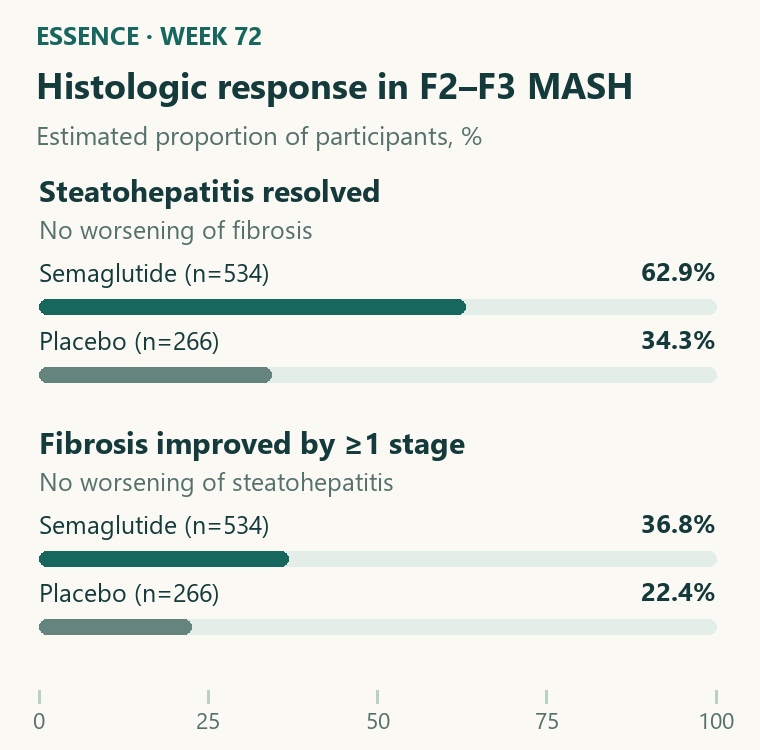
ESSENCE enrolled adults with biopsy-defined MASH and fibrosis stages F2–F3. In the first 800 analyzed at the 72-week interim assessment, the two principal histologic endpoints favored weekly semaglutide. MAESTRO-NASH reported greater steatohepatitis resolution and fibrosis improvement with resmetirom than placebo at week 52 in a trial cohort that also allowed F1B. The labels restrict MASH-directed use to the populations described above.
The trials differed in populations, endpoints and timing. A larger percentage in one trial cannot establish superiority over a drug studied in another trial. These accelerated approvals are based on histologic outcomes, with confirmatory effects on longer-term clinical outcomes still to be established. Evidence does not support routine dual MASH-targeted therapy simply because single-agent response is incomplete.
Interim analysis of 534 adults assigned weekly semaglutide and 266 assigned placebo, all with biopsy-defined MASH and F2–F3 fibrosis. The estimated differences were 28.7 percentage points (95% CI 21.1–36.2) for MASH resolution and 14.4 points (95% CI 7.5–21.3) for fibrosis improvement. The bars show trial estimates.
Sources[5] Phase 3 Trial of Semaglutide in Metabolic Dysfunction–Associated Steatohepatitis
[5] Phase 3 Trial of Semaglutide in Metabolic Dysfunction–Associated Steatohepatitis[6] A Phase 3, Randomized, Controlled Trial of Resmetirom in NASH with Liver Fibrosis[2] EASL-EASD-EASO guidance on the use of resmetirom and semaglutide as MASH-targeted therapy
Monitoring and escalation
Record baseline weight, nutrition and muscle status, glucose regimen, liver tests and fibrosis measurements. Reassess early with titration or medication changes. With semaglutide, revisit nausea, vomiting, oral intake, hydration, hypoglycemia when taking insulin or sulfonylureas, and potential gallbladder or pancreatic symptoms. With resmetirom, review symptoms and laboratory evidence of hepatotoxicity and relevant interactions, including gemfibrozil, clopidogrel and dose-limited statins. Check the label rather than relying on a class-wide interaction rule.
Follow trends using the same fibrosis modality and comparable conditions when feasible. Changes in transaminases, weight or stiffness can inform reassessment but do not prove histologic response in an individual. Investigate worsening stiffness or suspected new cirrhosis, falling platelets, jaundice, or decompensation. Revisit the diagnosis, adherence, residual metabolic risk and tolerability before changing therapy.
[1] Semaglutide therapy for metabolic dysfunction-associated steatohepatitis: AASLD Practice Guidance update[2] EASL-EASD-EASO guidance on the use of resmetirom and semaglutide as MASH-targeted therapy[3] Wegovy (semaglutide) U.S. prescribing information[4] Rezdiffra (resmetirom) U.S. prescribing information
Apply the pathway to two patients
A patient with obesity, type 2 diabetes and concordant noninvasive evidence of F3 fibrosis could benefit from a treatment that also addresses cardiometabolic goals. First exclude cirrhosis and review glucose-lowering medications, retinopathy, nutrition and gastrointestinal tolerance. Document which product and indication drive the prescription and who will monitor titration.
A patient with noncirrhotic F2–F3 MASH, a history of severe gastroparesis and an interacting lipid or antiplatelet regimen needs careful medication review. An oral option may be reasonable if interactions can be safely managed. Coordinate changes to antiplatelet or statin therapy with the prescribing clinician, and reassess the plan if the fibrosis evidence is discordant or the patient develops features of portal hypertension.
[1] Semaglutide therapy for metabolic dysfunction-associated steatohepatitis: AASLD Practice Guidance update[2] EASL-EASD-EASO guidance on the use of resmetirom and semaglutide as MASH-targeted therapy[3] Wegovy (semaglutide) U.S. prescribing information[4] Rezdiffra (resmetirom) U.S. prescribing information
References and scope
Original educational synthesis for clinicians. References support the sections linked above; their publication dates and scopes are shown separately from this guide’s source check. No source figure, question-bank item or guideline table is reproduced here.
- Semaglutide therapy for metabolic dysfunction-associated steatohepatitis: AASLD Practice Guidance updateBansal and colleagues · 2025
Society guidance
Source checked November 22, 2026 - EASL-EASD-EASO guidance on the use of resmetirom and semaglutide as MASH-targeted therapyEASL, EASD and EASO · 2026
Society guidance · DOI: 10.1016/j.jhep.2026.08.028
Source checked November 22, 2026 - Wegovy (semaglutide) U.S. prescribing informationFDA-approved labeling on DailyMed · 2026
Regulatory labeling
Source checked November 22, 2026 - Rezdiffra (resmetirom) U.S. prescribing informationFDA-approved labeling on DailyMed · 2026
Regulatory labeling
Source checked November 22, 2026 - Phase 3 Trial of Semaglutide in Metabolic Dysfunction–Associated SteatohepatitisSanyal and colleagues, ESSENCE investigators · 2025
Randomized controlled trial · DOI: 10.1056/NEJMoa2413258
Source checked November 22, 2026 - A Phase 3, Randomized, Controlled Trial of Resmetirom in NASH with Liver FibrosisHarrison and colleagues, MAESTRO-NASH investigators · 2024
Randomized controlled trial · DOI: 10.1056/NEJMoa2309000
Source checked November 22, 2026